Read free
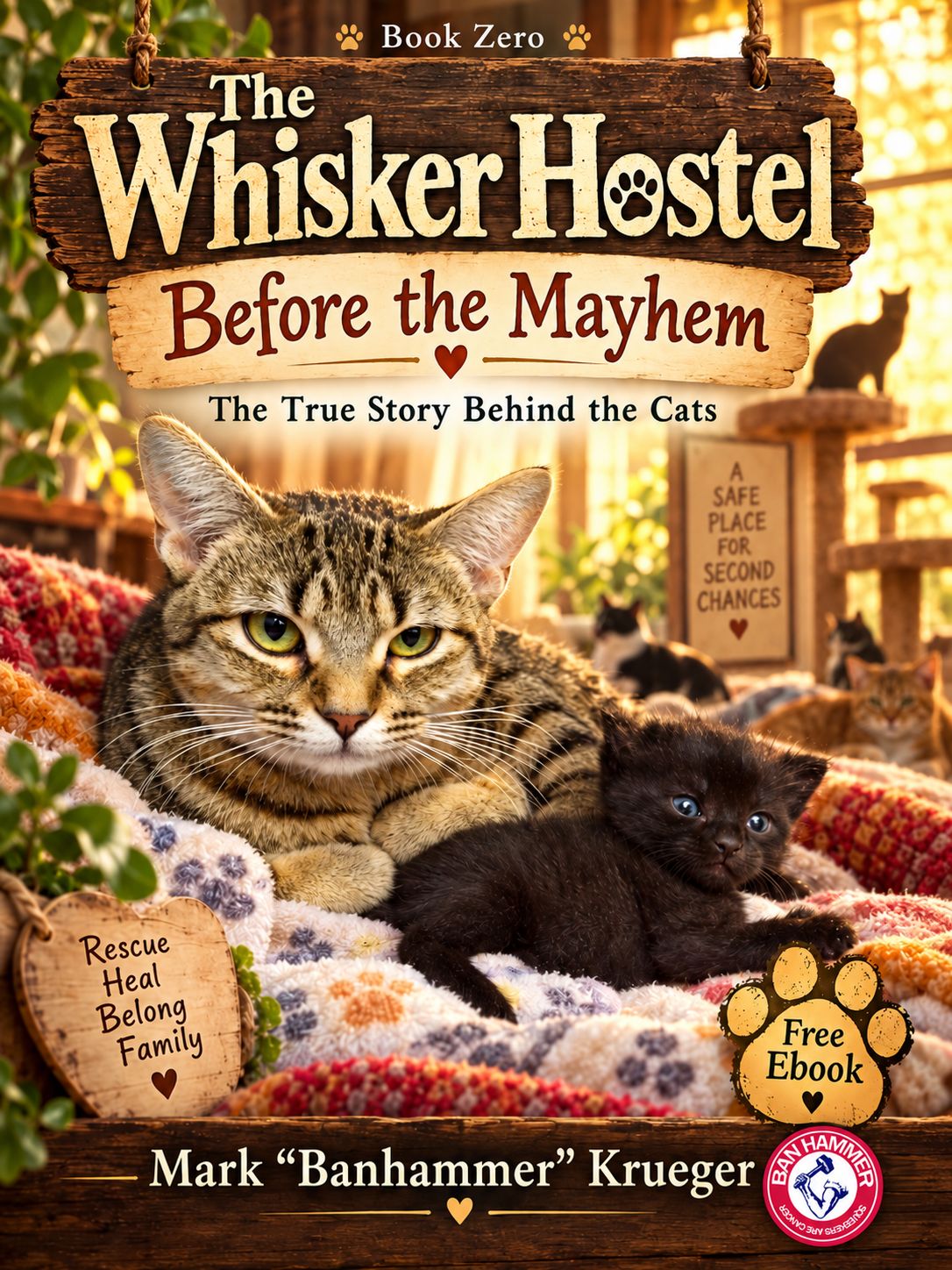
Before the Mayhem
The true story of how the cats came home and became a family.
Read the full storySixteen rescued cats. One human who pays the bills. A house where the cats have opinions about everything.
The true story of how the cats came home and became a family.
Read the full story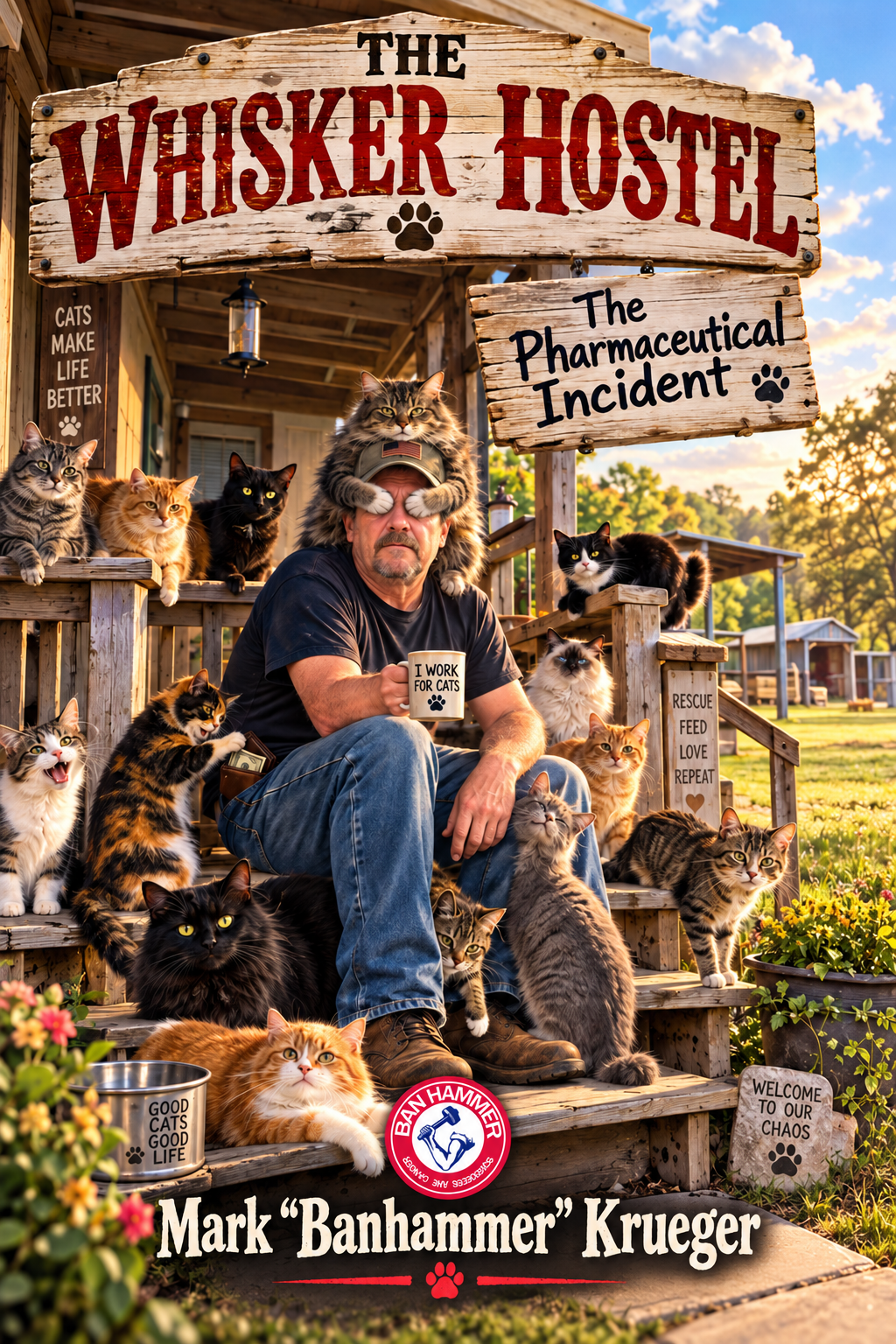
Giving one cat a pill should have been simple. The Whisker Hostel had other ideas.
Find the book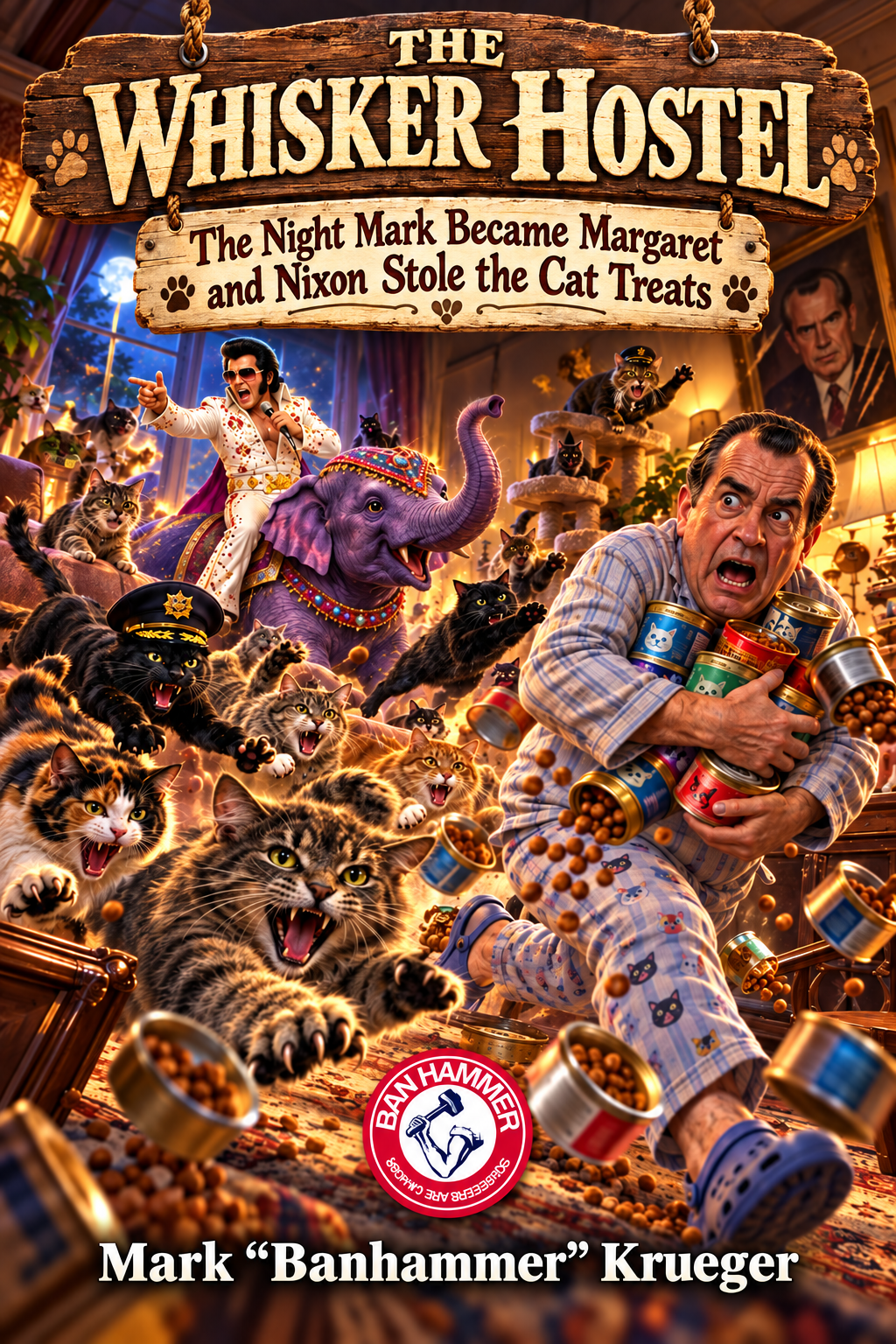
A household coup, three cans of Fancy Feast, and one very bad night for Nixon.
Find the bookI woke up one morning and realized I was completely alone in the world.
That sounds dramatic, but there really was no better way to describe it. My parents were gone. My marriage was gone. I lived in a very rural part of Oklahoma where there was no family around the corner, no neighbor I could casually lean on, and no easy way to pretend I was not suddenly by myself.
Except I was not actually by myself.
There were cats everywhere.
At the time, that did not feel like the beginning of anything. It certainly did not feel like the beginning of a book, a series of stories, or something that would eventually have a name like The Whisker Hostel. It just felt like life had collapsed and left me sitting in the middle of the wreckage with a house full of animals who still expected breakfast to be served on time.
Cats are wonderfully insensitive that way.
They do not care that your life has fallen apart. They do not care that you did not sleep. They do not care that you are staring at the ceiling trying to figure out what the hell happened. If breakfast normally arrives at seven, then at seven there will be a committee standing in front of you asking why management has failed.
That turned out to matter more than I understood at the time.
This is the part of The Whisker Hostel that comes before the jokes. Before the pharmaceutical disasters. Before the household coups. Before Nixon stole the Fancy Feast. Before I started turning the personalities of these cats into stories and letting them argue with me on paper.
This is how the house became what it is.
This is how the cats became the family that stayed.
None of this started because I wanted a house full of cats.
For most of my life, I thought of myself as more of a dog person. Eliza was the first cat who was really mine. My wife already had Mystica, and I had always wanted pets of my own. Since there was already a cat in the house, another cat seemed more conducive to the situation than introducing a dog.
I adopted Eliza while we were living in Arkansas.
I still remember her first night with me. She curled up in the bend of my elbow and fell asleep, and I stayed there most of the night barely moving because I did not want to disturb her.
Eliza is my oldest cat now, around twelve years old. She also has a place in my life that none of the others can ever have because she is the only cat still in my life who actually knew my parents before they passed away. She cannot possibly understand what that means to me, but she is one of the few living things around me that shared that part of my life.
Luna came later. I adopted her as a kitten in Seattle in 2019. Mystica was very old by then, and I knew she was not going to be around forever. Luna came into the family while life still looked like it had a recognizable shape.
When my wife and I eventually bought the house in Oklahoma, Luna and Eliza came with us. They were our cats.
Everybody else arrived later.
One rescue at a time.
Most of them were tiny kittens when I found them, often only three or four weeks old. Some were sick. Some were injured. Some were in such bad shape that without somebody stepping in, they probably were not going to make it.
So I did what you do.
You take them to the veterinarian. You spend money you had absolutely no intention of spending. You buy medicine. You feed them. You clean them. You worry about them. You wake up in the middle of the night to check whether a tiny animal is still breathing.
And you keep them inside while they recover because sending a sick three week old kitten back outside would be insane.
The problem is that three week old kittens eventually become four week old kittens. Then eight week old kittens. Then cats.
Cats who have grown up indoors.
Cats who have absolutely no idea how to survive outside and, frankly, have no particular interest in learning.
So they stayed.
One became two. Two became several. Several became what appears to be a privately operated cat sanctuary with no zoning approval whatsoever.
I never imagined that this would be my life.
I also would not trade it for anything.
They create chaos. They steal things. They knock perfectly good objects onto the floor for reasons known only to God. They occasionally organize against me.
And I love every damned one of them.
I would be absolutely lost without them.
Looking back, I think Jackie had been struggling for quite a while before she finally left. My health had been getting worse, and because she was also acting as my caregiver, that placed more responsibility on her. Around the same time, she was dealing with the loss of her father. Jackie had always struggled badly with anxiety, and I think the combination became more than she knew how to handle.
There was also somebody else. Eventually, she discovered that she was pregnant.
I cannot tell anybody exactly what was happening inside her head when everything finally collided. I can only tell you what happened and what I experienced.
We had been together for twelve years. Whatever had gone wrong between us, that is a long time to build a life with somebody. It is long enough that the routines become invisible. You do not think about the other person being there because being there is simply part of how the world works.
Then one morning the world works differently.
The last text she ever sent me was the morning she told me she was not coming home. She said she had taken her mother's phone, that her mother did not even know where she was, and that she had left the state with friends. She apologized, told me she loved me, and said she was dying inside and had lost herself.
About thirty minutes later, that same number called me again.
For a moment, I thought Jackie had reconsidered.
When I answered, however, I could hear her mother in the background. From the sound of things, they appeared to be together somewhere public.
That was when I realized the explanation she had given me did not add up.
I am not going to pretend I knew every detail that morning. I did not. I was stunned. I was trying to make sense of something that had gone from normal life to permanent separation in a matter of hours.
What I eventually understood was that Jackie had decided to find out whether the grass was really greener somewhere else.
Maybe she believed it was. Maybe she believed she had no other way forward. Maybe she was overwhelmed by grief, anxiety, responsibility, and everything else happening around her. I cannot answer those questions for her.
I only know that she left.
And I stayed.
That distinction became the center of my life for a while.
She was gone, but the mortgage was still here. The bills were still here. The house was still here. My medical problems were still here. The cats were definitely still here.
Nobody had explained the divorce of human civilization to them.
They only knew that one of their people had disappeared.
And some of them took that very hard.
A house can be physically identical and still become a completely different place overnight.
The furniture did not move. The walls did not move. The cats did not suddenly understand what had happened. But every room felt different because one person was missing from it.
There is a strange kind of silence that happens after somebody leaves for good. It is not actual silence. Not in this house. There are too many paws, too many litter boxes, too many food bowls, too many cats launching themselves from furniture at three in the morning for this place ever to qualify as silent.
But the human part of the house became quiet.
I had nobody to turn to in the next room and say, did you see what that cat just did?
Nobody to argue with about whether a cat had already been fed.
Nobody else who understood why one particular meow meant food, another meant attention, and another meant there was apparently a national emergency because somebody had closed a bathroom door.
The cats noticed the change too.
Rocky had been born in this house. Jackie had been there from the beginning of his life. Once he was old enough to come out with everybody else, he became intensely attached to her. After she disappeared, he stood in a corner and stared at nothing for roughly two weeks.
I could not explain it to him.
That was the worst part.
You can explain a divorce to another human being. You can explain betrayal, grief, fear, bad decisions, or somebody simply choosing another life. The explanation might not make anything better, but at least words exist for it.
There were no words I could give Rocky that would make him understand why the person he adored had simply vanished.
Later, Rocky died in my arms in the early morning. I cannot prove that Jackie's departure caused his death, and I will never claim that as a medical fact. What I can say is that I watched the change in him after she left, and I will never forget it.
Luna also became critically ill after Jackie left. I spent about two weeks going back and forth to the veterinarian trying to save her. There were moments when even the veterinarian did not sound confident that she was going to make it.
She did.
Luna survived.
That mattered.
During that period I was not doing particularly well myself. I was barely eating. I was not sleeping correctly. Everything that had once been divided between two people was suddenly sitting on one person who was already having trouble physically keeping up with ordinary life.
But the cats did not disappear simply because I was overwhelmed.
The house had changed, but it was still their house.
And whether I felt ready or not, I was still their person.
For a while I thought of the cats as another responsibility I had to survive.
Then somewhere along the way I realized they were also the reason I kept surviving the responsibilities.
That is not some sentimental line I invented after the fact. It was practical.
Cats require routine.
They need food whether you are depressed or not. They need water whether you are grieving or not. Litter boxes do not care whether you got three hours of sleep. A sick animal does not postpone being sick until your life gets easier.
When everything else had become unpredictable, the cats remained brutally predictable.
Breakfast.
Water.
Litter.
Medicine when somebody needed it.
A door somebody believed should be open.
A door somebody believed should be closed.
A bowl that was apparently acceptable yesterday but had become offensive today.
A cardboard box that immediately became more important than the expensive cat furniture sitting three feet away.
They kept demanding that the day continue.
That helped more than I knew.
They were not therapists. They were not tiny furry spiritual advisers. Half the time they were the reason something in the house was broken.
But they were there.
When you live alone, presence matters.
Spooky could sit across the room doing absolutely nothing and somehow make the room feel occupied. Luna could appear because she decided I had gone too long without paying attention to her. Henry could react to some completely ordinary sound as though hostile forces had breached the perimeter. Bubba could announce a concern at a volume normally reserved for tornado sirens.
Bella remained Bella, cautious and sweet and quietly observant. Cheech, Chong, and Casper operated with the general energy of three individuals who knew more than they were willing to disclose. Eliza maintained the seniority of somebody who had been around long enough to know that most household crises were stupid and would probably pass.
The important thing was that they did not leave.
They could not fix what had happened. They could not replace the people I had lost. They could not change my health or make rural Oklahoma less isolated.
They did something simpler.
They stayed alive with me.
Day after day.
That became enough to build on.
I stopped thinking of them as a collection of rescues and started understanding what they had become.
Family is not always the group you began with.
Sometimes it is the group still standing in the kitchen at seven in the morning screaming because breakfast is four minutes late.
There were also moments when I would look around the room and realize how strange the whole thing would appear to somebody seeing it for the first time. There might be a black cat on the back of the chair, another under the table, two tabbies watching from opposite sides of the room, somebody asleep on a blanket, and one cat staring directly at me with an expression that suggested I had disappointed the entire species.
To me, none of that looked unusual anymore.
I knew who was missing from the room without counting. I knew who was likely to be sleeping in another room. I knew which cat had probably made a noise based on where it came from. I knew which combinations of cats could share a space without drama and which combinations deserved supervision.
That kind of knowledge sneaks up on you.
One day you rescue a kitten. Years later you realize you have memorized the social structure of a small feline country.
I had lost a version of family. I did not replace it. You cannot replace people and you cannot erase history. But I did discover that the word family was larger than I had been treating it.
The cats were not substitutes.
They were themselves.
And they stayed.
After Jackie left, I was not looking to expand the household.
That needs to be made very clear.
By then I already had enough cats to qualify for either a rescue organization or a minor municipal government. I was not wandering around Oklahoma hoping another animal would appear and complicate my life.
Then there was Mama and her kids.
Mama, Sylvie, Princess, and Ernie became the only additions after Jackie left.
They were not part of some plan to keep collecting animals. The entire history of this house is basically a series of situations where an animal needed help and I was standing close enough to become responsible.
That is how rescues happen more often than people realize.
You do not wake up and say, I think I will dramatically alter the population of my home today.
You see a vulnerable animal. Then you see another. Then you start doing the math about food, veterinary care, space, and whether you can make it work.
Then you look at the animal again.
The math usually loses.
Mama became part of the household, and so did the kids.
Princess grew into the cat who plays fetch. She will bring something back and expects the human staff to understand the assignment. She also has a tail with two distinct kinks in it, which only adds to the impression that she was assembled from spare parts by a very creative committee.
Sylvie is her sister and almost the opposite kind of presence. Sylvie plays normally and bats toys around, but ordinary household activity does not automatically involve her. She is sweet, relaxed, affectionate, and generally uninterested in whatever political crisis the other cats have invented. Something genuinely significant has to happen before Sylvie decides it deserves her attention.
Ernie is a golden tabby and one of the normal ones, which in this house is a dangerous phrase because normal is always subject to review. He is curious and affectionate without automatically inserting himself into every disaster.
Mama is Mama. She has the calm energy of somebody who has already raised children and is not impressed by anybody else's nonsense.
Bringing them inside did not erase what had happened before. It did something else.
It proved the house was still capable of becoming more than the place where somebody had left me.
There was still room for something to arrive instead of disappear.
That mattered too.
The Whisker Hostel did not stop at the walls of the house.
For a long time there were outside cats too. A lot of them.
At one point there were roughly twenty five around the property and surrounding area. Some were regulars. Some appeared long enough to eat and then vanished back into whatever private life they were conducting beyond my knowledge. Some became familiar enough that I worried when they did not show up.
Rural life is not gentle with small animals.
There are cars, weather, predators, disease, people who do not care, and people who actively make things worse. You learn quickly that caring about an outdoor animal does not give you control over what happens to it.
That is difficult when your instinct is to fix things.
I could put out food. I could provide water. I could watch for injuries. I could try to make the property safer. I could intervene when I realistically had the ability to intervene.
I could not turn the entire countryside into a protected cat sanctuary.
Believe me, the cats would have supported the zoning change.
The outside cats also changed the rhythm of the place. You would look outside and see somebody waiting. You would walk toward the feeding area and suddenly discover that an informal board meeting had already begun.
Some of them trusted me. Some tolerated me because I controlled the food supply. Some made it very clear that our relationship was contractual and should not be confused with friendship.
That is another thing cats are good at. They are excellent at maintaining boundaries while standing on your property eating food you purchased.
There were losses too.
That is unavoidable when you care for animals you cannot completely protect. Some disappeared. Some died. Some simply stopped coming around, leaving you with no answer about what happened.
Those are the parts people do not see when they look at a funny picture of a man surrounded by cats.
Rescue is not just the moment when you save one.
It is also the worrying afterward.
It is noticing who did not come to dinner.
It is walking outside because you heard a noise.
It is spending money on food for animals who technically do not belong to you and then feeling personally betrayed when one of them acts like you are a suspicious stranger.
The inside cats became the family living with me.
The outside cats became part of the larger world surrounding the house.
Together they made it impossible to believe I was truly alone, even on the days when I felt that way.
Taking care of the outside cats also changed the way I thought about responsibility. There is a temptation to believe responsibility begins only after ownership. I never believed that. If an animal is hungry in front of me, the paperwork concerning ownership is not the first thing I think about.
That attitude is probably how I ended up with this many cats in the first place.
It is also why there is a difference between saying an animal is mine and saying an animal matters to me. Plenty of the outside cats were never mine. They still mattered.
Some of the hardest lessons in rescue come from that distinction. You can care deeply and still have limits. You can provide food and safety where you can and still fail to control the whole world around an animal. Learning that did not make the losses easier, but it kept me from pretending love automatically gives a person power.
Sometimes all you can do is make one small part of the world safer for as long as the animal chooses to stay there.
The stories came later.
For years the cats had personalities whether anybody outside the house knew about them or not.
Luna did not become administrative because I wrote her that way. I wrote her that way because she already carried herself like somebody who expected documentation before approving anything.
Spooky did not become the intimidating old professional because I needed a character. He already had the ability to sit perfectly still and somehow communicate that everybody else in the room should reconsider their decisions.
Henry was already Henry. Bubba was already loud enough to trigger a household response team. Casper already possessed the apparent ability to stop existing whenever somebody needed to find him.
I eventually started turning those personalities into stories.
The events could be fictional. The cats were not.
That distinction became the whole point.
I could take something recognizable about each cat and exaggerate the situation around it until the house became a little fictional universe. Luna could run an administrative hearing. Spooky could become a tactical commander. Casper could disappear into areas of physics unavailable to human beings. Princess could negotiate treat policy. Cheech and Chong could become partners in whatever investigation or criminal enterprise the evening required.
The humor worked because the personality underneath it was real.
The first time people responded strongly to one of the stories, I realized something else.
I was laughing too.
That may sound obvious, but it was not.
For a long time after everything fell apart, most of the stories I told about my life were stories about what had gone wrong. Loss. Betrayal. Illness. Bureaucracy. Things I was fighting. Things that had happened to me.
The cats gave me another category.
They gave me ridiculous things that happened around me.
There is a difference.
You can survive a terrible period and still accidentally build a mythology around a cat knocking a cup off a table.
You can have serious problems and still spend twenty minutes arguing with an animal who does not speak English.
You can wake up angry at the world and then discover that Princess has brought you something because apparently fetch is now on the schedule.
The stories did not erase the bad things.
They gave the bad things competition.
That became important.
Eventually the stories had recurring personalities, recurring jokes, household politics, disasters, negotiations, covert operations, and a human character who was usually several steps behind the cats despite technically owning the property.
At some point I realized the whole thing needed a name.
The name The Whisker Hostel fit because it described the place better than anything else I had come up with.
This was never a carefully planned rescue organization.
There was no business plan. No intake department. No strategic growth model. No committee deciding how many cats the building could support.
There was usually just a cat who needed help and a human being making another questionable financial decision.
The cats checked in.
Some were supposed to be temporary.
Temporary is a dangerous word in animal rescue.
You bring in a kitten because it is sick. You get it healthy. You keep it inside while it recovers. You feed it every day. It starts sleeping somewhere near you. It learns the sounds of the house. You learn the sound of its particular meow. It develops opinions about food.
Then one day you realize that sending it away feels less like completing a rescue and more like removing somebody from the family.
So it stays.
That happened enough times that the household became what it is now.
The Whisker Hostel.
The cats can check in anytime they like, but I can never leave.
It is a joke, obviously.
Mostly.
The name also gave the stories a home. They were no longer disconnected jokes about random cats. They happened in the same place, with the same cast, under the same completely ineffective human administration.
The house became a character too.
This rural Oklahoma home where nothing is close, everything takes planning, emergency help can take a long time, and a trip for something simple can consume half a day somehow became the headquarters of a fictional cat empire.
There is something fitting about that.
The place that once felt painfully isolated became full of voices, even if most of those voices existed because I was translating facial expressions from animals who were probably thinking about food.
The Whisker Hostel is fictional in the way the stories work.
The author is real. The house is real. Every cat is real.
Their names are real. Their personalities are real. Their quirks are real. The bond is real.
The adventures are what happen when I take all of that and ask one dangerous question.
What if the cats could explain themselves?
Based on the evidence so far, I am fairly certain they would blame me for everything.
People sometimes ask what an ordinary day with this many cats looks like.
There is no ordinary day.
There are routines, certainly.
Litter has to be handled every day. Food has to be managed. Water has to be dealt with. Somebody wants attention. Somebody does not want attention but has chosen to sit exactly where attention is unavoidable. Somebody has found an object that was not intended to be a cat toy and has submitted it for immediate reclassification.
Wet food happens once a day. The kitchen is supposed to be a cat free area, which means the cats regard the kitchen as a restricted military installation worthy of surveillance.
Every cat has a different way of participating in the household.
Luna wants attention and tends to approach life as though policy should exist for it.
Spooky is the godfather. He does not need to create chaos. His strength is making everybody wonder whether he might.
Henry is suspicious of existence itself. A sound can happen two rooms away and Henry may decide civilization is under attack.
Bubba is the emergency broadcast system. If Bubba is unhappy, everybody will receive the notification whether they subscribed or not.
Bella is timid and careful. That does not mean she is incapable of deception. I learned that lesson during the pharmaceutical incident and would prefer not to discuss it without legal representation.
Cheech and Chong have the energy of two individuals who should not be left unsupervised near evidence.
Casper disappears whenever the household requires his presence, which I believe is a skill he practices deliberately.
Eliza has seniority and the attitude of somebody who has watched enough nonsense to know most of it does not deserve a response.
Spice is a solid long haired gray cat who can turn being wrapped in a towel into a negotiation over international law.
Princess plays fetch and occasionally behaves as if she is running an acquisition program for small objects.
Sylvie is sweet, relaxed, affectionate, and usually above the drama unless something loud enough happens to make ignoring it impossible.
Bert and Ernie are normal, curious, affectionate cats, which is why I try not to drag them into every fictional crime simply because the rest of the household has poor impulse control.
Mama has the calm neutrality of somebody who has already raised children and does not intend to volunteer for another committee.
Then there are the moments nobody can plan.
A crash in another room.
A cat racing down the hallway at a speed unsupported by any obvious emergency.
A toy appearing somewhere it absolutely was not placed.
Six cats suddenly staring at the same blank section of wall, forcing the human occupant to consider either ghosts or an insect.
Someone deciding that four in the morning is the correct time to discuss breakfast policy.
The house is exhausting.
It is expensive.
It is frequently ridiculous.
It is also alive.
That is the part I would miss most if it ever became quiet.
There is a phrase people use when life gets bad.
Rock bottom.
I used to think that sounded definitive.
Then I discovered rock bottom apparently has a basement.
After Jackie left, the problems did not politely wait for me to recover emotionally before arriving one at a time.
Life does not have that kind of project management.
There were financial problems. There were medical problems. There were practical problems that become much larger when you live in a rural place and do not have another person in the house to split them with.
The van eventually disappeared from my life too. Bills remained. Debts remained. Things broke. Transportation became harder. My own physical limitations became harder to work around.
Meanwhile the cats continued operating under the assumption that the food supply was a constitutional right.
There were nights when I honestly had no idea what the long term plan was.
That is different from saying I wanted to give up.
It means I could not see very far ahead.
Sometimes survival becomes embarrassingly small.
Feed the cats.
Eat something.
Take care of the thing directly in front of you.
Get through the night.
Try again tomorrow.
People like stories where somebody reaches the bottom and then has a grand realization. Music swells. The person stands up. Everything changes.
Real life is usually less cinematic.
You stand up because a litter box needs cleaning.
You go to the kitchen because a cat is yelling.
You make a phone call because some bureaucratic problem will get worse if you do not.
You do one thing, then another thing, then another.
Months later you look around and realize you are still here.
That was my version.
The cats did not save me in some magical way. I want to be careful about saying that because it turns real animals into a greeting card message.
They did something more concrete.
They gave me obligations that continued past whatever mood I was in.
They gave the house movement.
They gave me creatures to worry about besides myself.
They gave me reasons to spend money I did not want to spend, clean things I did not want to clean, and get out of bed when staying there would have been easier.
Eventually they also gave me something to write about that made people laugh.
That may not sound profound.
It was profound to me.
When your life has become a collection of things you are fighting, laughter is evidence that the fight has not taken everything.
There was another change happening at the same time. I stopped measuring progress only by whether the old life came back.
For a long time that is what recovery can feel like. You compare every day to the day before everything changed. You keep waiting to feel like the person you were, living the life you had, with the people who used to be there.
Eventually I understood that I was not going backward.
Whatever came next had to be built forward.
That was harder, because building forward meant accepting that some things were really over. It also meant admitting that new things could still matter.
A ridiculous cat story could matter.
A reader laughing could matter.
A quiet night with everybody fed and safe could matter.
Getting through a week without some new catastrophe could feel like a major strategic victory.
None of those things restored what I lost. They became part of what I still had.
I did not start writing The Whisker Hostel because I thought I was launching a literary franchise.
I started because the cats are funny.
Then I kept going because people enjoyed the stories.
Then I realized the stories were doing something for me too.
They were taking years of chaos and turning part of it into something I could use.
That matters to me because I have spent enough of my life being defined by what happened to me.
Loss can do that.
Illness can do that.
Betrayal can do that.
Bureaucracy can definitely do that.
Eventually you start telling your own life as a list of disasters because those are the events that demanded the most attention.
The cats interrupted that narrative.
They gave me other stories.
Stories about a household government that nobody elected.
Stories about medication disasters.
Stories about covert food operations.
Stories where Richard Nixon can steal the Fancy Feast because, frankly, reality had already become strange enough that I no longer saw a reason to impose unnecessary limits on fiction.
The important part is that underneath every ridiculous story is something real.
These cats were rescued.
Many of them were tiny and vulnerable when they came here.
They needed veterinary care, food, medicine, time, protection, and a safe place to grow up.
They became adults in this house.
They became a family in this house.
Then when my human family changed, they were still here.
That is why I am finally telling the part that came before the jokes.
I do not want readers to think The Whisker Hostel appeared fully formed as a comedy universe with a cast of sixteen cats and one idiot.
It came out of rescue.
It came out of grief.
It came out of a house that had become too quiet in one way and impossibly loud in another.
It came out of learning that family can survive a change in form.
It came out of realizing that I could tell the truth about difficult years without making pain the only thing worth remembering.
The Whisker Hostel is not me pretending the bad things never happened. It is what happened when I finally stopped allowing the bad things to be the only part of the story worth telling.
The cats were never created as book characters.
They were lives that needed saving.
Somewhere along the way, while I was trying to keep them safe, they became part of what kept me moving too.
I did not choose most of the circumstances that built this place.
But I can choose what I build from them now.
With a little help from God and a house full of cats, I think I did.
I am still building it.
There will be more bad days. There will be more medical problems, more bills, more things around the house that decide to break at the least convenient possible moment. There will be cats who get sick and cats who scare the hell out of me and cats who create emergencies that turn out not to be emergencies at all.
There will also be more stories.
That is the deal now.
Life happens. The cats interfere. I write it down.
Somewhere between those three things, The Whisker Hostel keeps going.
If you enjoyed this story and would like to support me and the cats who inspired The Whisker Hostel, you can find my other stories here:
They are only $2.99 each, and every purchase helps support me, the cats, and the continuing adventures of The Whisker Hostel.
Thank you for reading, and thank you for helping me keep these little bastards fed.